
Replacing a furnace is a substantial purchase, and the first estimate you receive may not tell you whether replacement is necessary—or whether the proposed equipment is right for your home. If you’re considering furnace installation in Tulsa, start with the diagnosis, the heating needs of the house, and exactly what the contractor plans to install. Those details matter more than a brand name or a low advertised starting price.
This guide is for homeowners comparing a new gas furnace, evaluating a repair recommendation, or considering a heat pump instead. It explains what belongs in a useful estimate and which questions can prevent expensive misunderstandings.
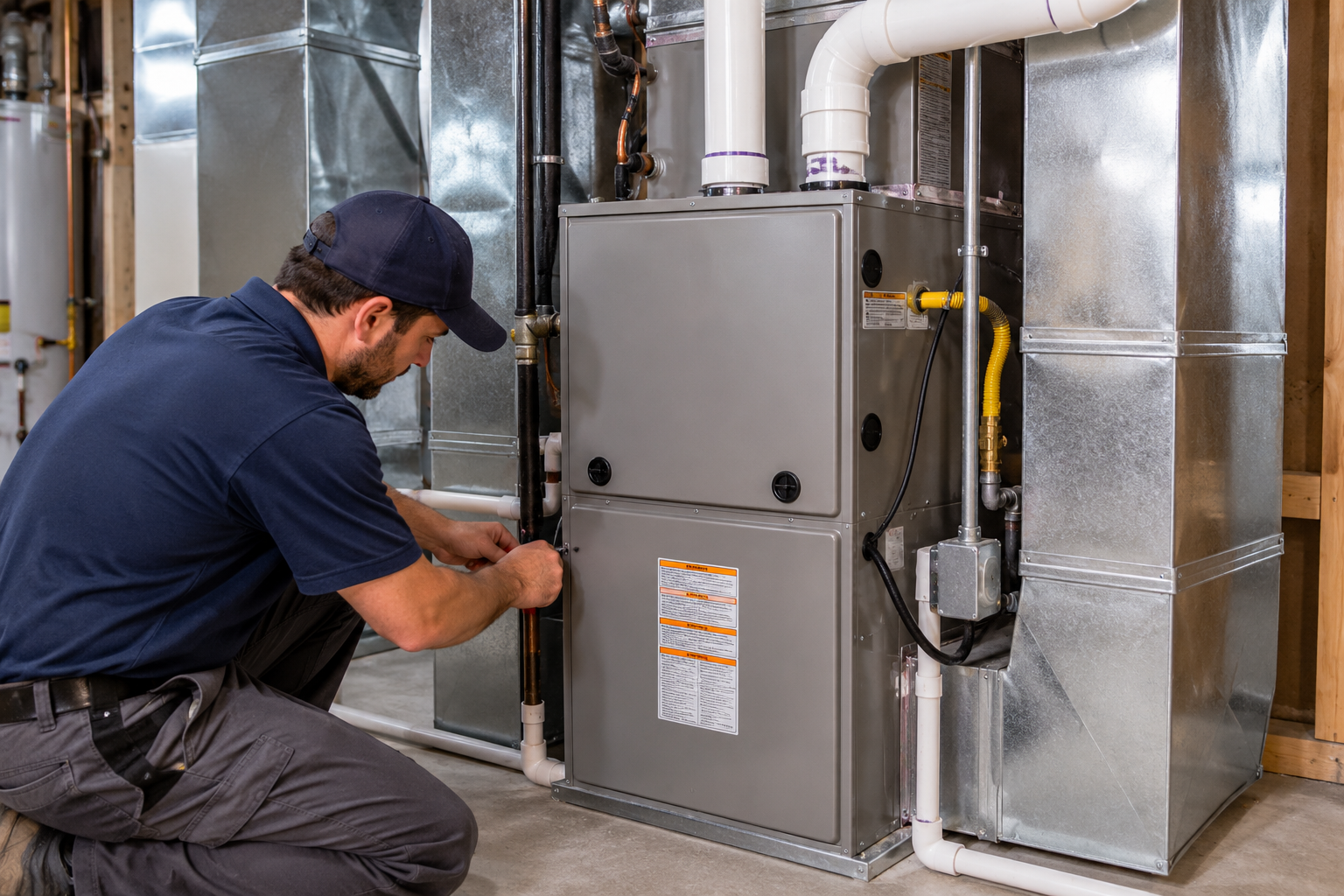
Do you need a new furnace, or would a repair make sense?
A furnace that has stopped heating does not automatically need replacement. A failed igniter, sensor, thermostat, or other replaceable component may be repairable, depending on the diagnosis and condition of the equipment. On the other hand, a serious heat-exchanger concern, repeated expensive breakdowns, or a system that no longer heats the home reliably can change the economics.
Age is a useful clue, not a verdict. ENERGY STAR suggests considering replacement when a furnace or boiler is more than 15 years old, especially alongside rising bills, frequent repairs, or comfort problems. That does not mean every 15-year-old furnace should be removed. Ask the technician to explain what failed, what the repair would cost, and what condition the rest of the system is in. ENERGY STAR’s replacement guidance provides a useful starting point.
If a contractor raises a possible cracked heat exchanger or carbon monoxide concern, treat it as a safety issue rather than an ordinary repair-versus-replace calculation. Do not operate equipment declared unsafe; ask for the findings in writing and seek qualified evaluation. If a carbon monoxide alarm sounds or anyone has symptoms consistent with exposure, leave the building and contact emergency services.
Repair may make sense
The problem is isolated, the repair is reasonably priced, and the furnace otherwise heats reliably. Ask for a written diagnosis.
Replacement deserves a closer look
Major safety concerns, recurring expensive failures, or persistent comfort problems can justify comparing replacement options.
A replacement furnace should be sized for the house—not copied from the old label
Furnaces are rated in British thermal units per hour (BTU/h), a measure of heating capacity. A larger number does not necessarily mean a better furnace. An oversized system can heat the thermostat area quickly, shut off, and leave other rooms uncomfortable. An undersized system may struggle during cold weather.
A proper heating-load calculation accounts for factors such as the home’s size, insulation, windows, air leakage, and local design temperatures. Ask whether the contractor performed a Manual J calculation, which estimates the heating and cooling load. Replacing an old 100,000-BTU furnace with another 100,000-BTU furnace simply because the label matches is not a substitute for checking what the home actually needs. ENERGY STAR also recommends Manual J-based sizing. See its equipment-sizing guidance.
The ductwork matters, too. A new furnace cannot distribute heat evenly if the ducts are undersized, leaking, disconnected, or poorly balanced. If bedrooms have always been colder than the living room, bring that up before the contractor quotes equipment. Otherwise, you may pay for a new furnace and keep the same comfort problem.
What Tulsa furnace installation prices actually tell you
Published Tulsa-area prices are useful as comparison points, but they are not interchangeable estimates. Good Neighbor Heating & Air lists furnace replacement at $1,999–$8,999 and says its advertised furnace scope includes equipment, installation labor, gas-line connection, a safety inspection, and a one-year labor warranty. Its furnace listing does not expressly identify a permit as included, although its AC replacement listing does. That is exactly the kind of distinction to clarify in writing before signing.
TemperaturePro’s Tulsa cost guide gives a $4,500–$6,000 average and a wider $2,800–$10,000 range for installed furnaces. These are figures published by a contractor, not audited records of what Tulsa households paid. They show the range of claims homeowners encounter, not a verified market average.
The advertised $1,999 entry price is not proof that your project should cost $1,999. It may require different equipment, venting, gas-line changes, duct modifications, or additional labor. Likewise, a higher estimate is not necessarily excessive if it includes work another proposal leaves out. Request the exact furnace model, labor scope, permit and inspection handling, removal of the old unit, warranty terms, and the cost of any proposed ductwork.
A useful comparison question is: ‘What would make the final bill higher than this written estimate?’ If one contractor includes venting changes and another assumes existing venting is reusable, the prices are not describing the same job.
Good Neighbor advertised range
$1,999–$8,999 for furnace replacement. Confirm which model, installation work, and permit costs are included. See the linked contractor listing in the pricing discussion above for the advertised scope.
TemperaturePro cost guide
$2,800–$10,000 published range; its stated average is $4,500–$6,000. These are contractor figures, not independently audited local averages.
Tulsa permits and inspections: what to verify before work begins
The City of Tulsa’s permit center publishes a mechanical permit request form; the form specifically identifies central furnaces among the work categories. The city also operates an inspection scheduling service. Before hiring, ask the installer whether a mechanical permit is required for your exact scope of work, who will obtain it, who pays the fee, and who arranges the final inspection.
A Tulsa mailing address does not necessarily mean the property is inside Tulsa city limits. If your home is in a neighboring municipality or an unincorporated area, confirm the authority having jurisdiction rather than relying on the City of Tulsa’s process. Permit requirements should be checked for the actual property address.
There is also a timing detail worth knowing: Tulsa’s inspection-services page says the city is working toward local adoption of updated building codes with a pending January 1, 2027 date. Ask the permitting authority and installer which code edition applies when your permit is submitted; do not assume the rules remain unchanged between estimates and installation.
Tulsa permit checkpoint
A Tulsa mailing address does not always mean the property falls under City of Tulsa permitting. Ask which jurisdiction applies, who obtains the mechanical permit, and who schedules the inspection.
Efficiency: what AFUE means and when paying more may be worthwhile
A gas furnace’s annual fuel utilization efficiency, or AFUE, expresses the share of fuel energy converted to useful heat under a standardized test. An 80% AFUE furnace and a 95% AFUE furnace do not necessarily deliver the same annual fuel bill, because actual consumption also depends on sizing, usage, duct losses, and the home itself. Higher-efficiency condensing furnaces also have different venting and condensate-drain requirements, which may increase installation complexity.
ENERGY STAR’s current gas-furnace criteria for the U.S. South, which includes Oklahoma, require at least 95% AFUE. That is an ENERGY STAR certification threshold, not a statement that every replacement must meet it. See the ENERGY STAR criteria. Ask the installer to compare the installed cost of suitable options against a realistic estimate of annual fuel savings, rather than assuming the most expensive furnace always pays for itself.
Should you consider a heat pump instead of another gas furnace?
A heat pump uses electricity to move heat rather than producing it through combustion. Many systems can both heat and cool a home, so the comparison becomes especially relevant when the air conditioner also needs replacement. A dual-fuel setup pairs a heat pump with a gas furnace and can switch heating sources under selected conditions.
The right choice depends on the home’s electrical service, existing ductwork, equipment compatibility, local utility rates, installation cost, and how the system performs during colder weather. Ask for a side-by-side estimate if both options are practical. Our Tulsa AC installation and replacement guide covers some of the same sizing and system-matching decisions.
When a heat pump comparison is worth requesting
If your air conditioner also needs replacement, ask for a side-by-side installed estimate for a heat pump and a gas-furnace option. Compare the whole system—not just the heating unit.
Comparing gas and electric heating costs in Tulsa
For a Tulsa homeowner choosing between another gas furnace, a heat pump, or a dual-fuel system, local utility bills are more useful than a national claim about which fuel is cheaper. Public Service Company of Oklahoma publishes its current residential electricity tariffs and an October 2026 bill-calculation spreadsheet. Those schedules can include charges beyond a simple per-kilowatt-hour rate. A contractor’s savings estimate should identify the electricity price, natural-gas price, and assumed heating demand used in the comparison.
If you have gas service, use the rate and charges shown on your own gas bill rather than treating a statewide average as your household price. The comparison also needs to account for how a heat pump performs in colder weather and whether backup heating is required. Without those inputs, a precise annual savings claim would be misleading.
Five things to check on every quote
- Exact furnace model and installed price
- Heating-load calculation and equipment size
- Venting, gas, and ductwork changes
- Permit and inspection responsibilities
- Labor and equipment warranty terms
What should a complete installation estimate include?
A useful furnace quote identifies the manufacturer and model numbers, heating capacity, AFUE rating, and whether the system uses a single-stage, two-stage, or modulating burner. These describe how the furnace produces heat at different demand levels. The proposal should also explain the blower arrangement, thermostat compatibility, warranty terms, and whether the price includes removing the old furnace.
Ask specifically about venting, combustion-air requirements, gas piping, electrical connections, condensate drainage if applicable, and any needed duct transitions. The contractor should confirm that the new furnace and existing air-conditioning components can work together. A proposal that says only ‘install new high-efficiency furnace’ leaves too much room for confusion.
Before work begins, confirm who handles required permits and inspections and whether startup testing is included. At handover, ask the installer to explain the filter arrangement, thermostat operation, maintenance requirements, and where the system’s paperwork is kept. Installation quality can matter as much as the brand printed on the cabinet.
Choosing a furnace installer in Tulsa
Oklahoma’s Construction Industries Board provides a public licensee search for mechanical trades. Verify the contractor’s credential before accepting a proposal; a company name on a truck or a general business registration is not the same as an active mechanical-contractor license. The Board also describes bond and insurance maintenance requirements for licensed mechanical contractors. Ask who will supervise the installation and whether the written quote includes any required city permit and inspection.
When you obtain more than one estimate, compare the proposed equipment, sizing method, scope, warranty, and commissioning work—not just the final number. If one contractor recommends a dramatically larger furnace or a costly duct modification, ask them to explain the calculation or observed problem behind that recommendation. A second opinion is particularly useful when a major replacement is recommended after a brief visit.
What happens on installation day?
A typical replacement involves isolating the old equipment, removing it, setting and connecting the new furnace, adapting any required duct, vent, gas, electrical, or drain connections, and testing the completed installation. The exact work and duration depend on the house and system. Fuel and electrical connections, combustion safety checks, and startup adjustments are professional tasks—not homeowner DIY steps.
Before the installer leaves, ask for a walkthrough of the thermostat and filter, copies of equipment model and serial numbers, warranty documents, and an explanation of any follow-up inspection. If the new furnace makes unfamiliar noises, heats unevenly, or cycles unexpectedly, report the symptoms promptly rather than assuming they are normal.
Before the installer leaves
Get the equipment model and serial numbers, warranty documents, filter and thermostat instructions, and confirmation of any outstanding inspection or follow-up work.
Getting ready to compare furnace installation estimates
Gather the existing furnace’s approximate age, model information if accessible, recent repair history, and notes about rooms that are difficult to heat. Tell contractors whether the air conditioner is also nearing replacement, because that can affect the most economical system design. If the furnace is still repairable, ask for the repair option in writing alongside the replacement recommendation.
Home Climate Advisor provides independent homeowner education. We do not currently install furnaces, dispatch technicians, or claim verified contractor partnerships. If your immediate issue is a loss of heat rather than a planned replacement, start with our Tulsa furnace repair guide and the Tulsa HVAC services hub.